Yamane-ryū: 山根流棒術
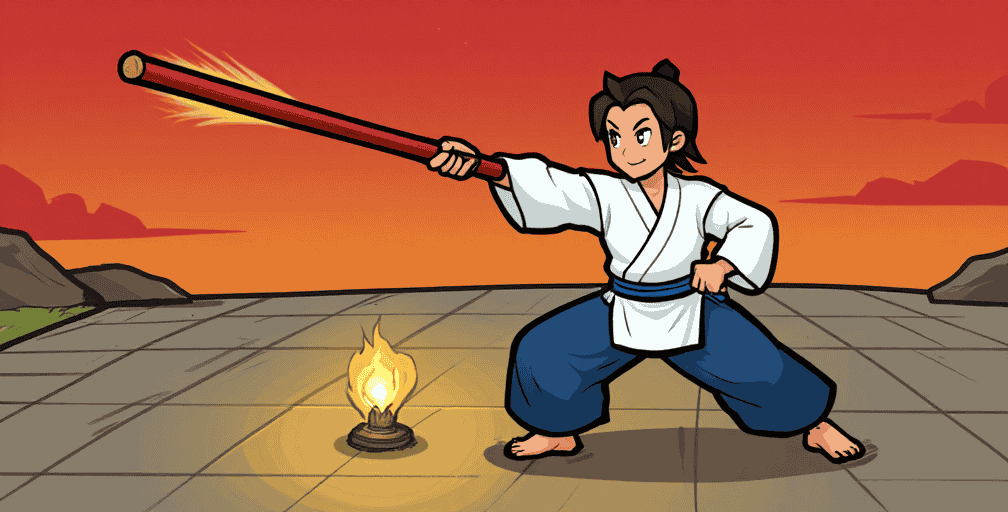
Yamane‑ryu (also written Yamanni‑ryu or 山根流 / 山西流 in some sources) is a Ryukyuan weapons tradition whose core is rokushaku bōjutsu characterized by fluid, rebounding motion, continuous body dynamics, and distinctive footwork. Sources such as the IRKRS Yamane Ryu page, RBKD Germany, and the Ryukyu Bujutsu Kenkyu Doyukai describe this style. Where the Taira line systematizes multiple weapon categories, Yamane‑ryu's identity is built entirely around the long staff.
The style is usually written 山根流棒術 (Yamane‑ryū bōjutsu), also seen as 山根知念流棒術 in some contexts according to Gen Universe. Japanese writers stress that this is a specific family school, not a generic label for "Okinawan bōjutsu," as noted in a detailed note article. While once an obscure style confined largely to Okinawa, it has developed into an internationally practiced system through several modern lines, most notably the Kishaba‑ha / RBKD branch and Patrick McCarthy's Oshiro‑ha Yamane‑ryu, while also influencing other kobudō and karate schools (see Wikipedia, RBKD).
Technically, the style is known for fluid, continuous staff motion and a curriculum built around classical kata such as 周氏の棍(しゅうしのこん), 佐久川の棍(さくがわのこん), 白樽の棍(しらたるのこん), and 米川の棍(よねがわのこん), as documented by Kyudomugen.
Yamane‑ryū is a family‑style Okinawan bōjutsu tradition with a very clear written lineage in Japanese sources; a note article observes that most modern Okinawan staff work can be traced back to it in some way.
Founder and Early History
Chinen Sanda (Chinen Masanra / 知念真三良 / 知念三良)
Standard lineages trace Yamane‑ryu's roots to the legendary bō master Sakugawa Kanga (1733–1815), who is said to have brought a staff‑fighting art from China to Okinawa in the late eighteenth century and to have transmitted it to the Chinen family. Chinen Chikudun Pechin transmitted this material to his son Chinen Sanda (c. 1842–1925), also known as Chinen Pechin, Yamani‑no‑Chinen, or Yamane Tanmei. This lineage is documented in McCarthy's Yamane Ryu essay, the Okinawa Karate Center, RBKD Germany, and Wikipedia.
Japanese biographical summaries identify the founder as 知念真三良(ちねん まさんら/まさら), often written more simply as 知念三良 in later articles according to a note article. Dates: c. 1834–1925 (Kyudomugen).
Yamane‑ryu sources describe Chinen Sanda as a Pechin‑class retainer from Samukawa village in Shuri, educated in Uchinadi by his uncle Chinen Sanjin Andaya Pechin (Aburaiya Yamagusuku). He is credited with synthesizing Sakugawa's and Chatan Yara's staff methods into a fluid bōjutsu characterized by a "bouncing" or rebounding motion of the staff, which became the hallmark of the style, as described in McCarthy's Yamane Ryu essay, RBKD materials, and the Okinawa Karate Center.
Key points from Japanese sources:
- As a young man around age 18, Chinen went to Tsuken Island(津堅島) to train under a noted bō master; this Tsuken training is cited as a root of his later system (Kyudomugen).
- His bōjutsu school came to be called 山根流棒術, and he was known especially for the kata 周氏の棍, 佐久川の棍, 白樽の棍, and 米川の棍 (Kyudomugen).
- An Okinawan newspaper report from 1918 (『琉球新報』大正7年3月21日号) records 知念三良 performing kobudō at the Okinawa Prefectural Normal School together with 本部朝勇(もとぶ ちょうゆう), showing that he was counted among the top karate/kobudō figures of his time according to a note article.
Major Disciples of Chinen Sanda
Major disciples listed in Japanese sources include:
- 屋比久孟伝(やびく むでん, 1878–1941), who later founded the 琉球古武術研究会 and taught bō and sai to 平信賢(たいら しんけん).
- 大城朝恕(おしろ ちょうじょ, 1887–1935), remembered for his spectacular bō (and later central in the Oshiro‑系 Yamane material).
- 知念正美(ちねん まさみ, 1898–1976), his grandson and postwar head of the school.
- 瑞慶覧町徳(ずけらん ちょうとく), 与那覇正牛(よなは せいぎゅう) and others (Kyudomugen).
A Taiwanese‑language blog summarizing Okinawan kobudō, based on Japanese articles, likewise states that Yabiku Moden 「棒術是從棒術名家 山根流的創始者 知念親雲上真三郎習得」—Yabiku learned bō from "Chinen Pechin Masanra," founder of Yamane‑ryū bōjutsu, confirming this connection.
Okinawa Karate Information Center material indicates that these students and others received Yamane material, including the Higa family (Raisuke, Seiichirō, Ginsaburō), Akamine Yohei, and Maeshiro Chōtoku. This diffusion meant that Yamane‑line kata and methods entered multiple Okinawan kobudō systems (e.g., Yabiku–Taira line, Akamine/Nakamoto Ryukyuan kobudō, various Shōrin‑ryū kobudō curricula) even when the label "Yamane‑ryu" was not used, as documented in karatekobudo.com history.
Naming and Codification by Chinen Masami (1898–1976)
Chinen Sanda's grandson Chinen Masami (1898–1976) is generally regarded as the person who named the system "Yamane‑ryu" (Yamani‑ryu), combining characters meaning "mountain" (山) and "root/foundation" (根) with "ryū" (流, stream) to reflect the Samukawa locale from which the tradition came, as documented by the Okinawa Karate Center, Wendell Wilson's Yamanni-Ryu Kata, McCarthy's Yamane Ryu essay, and karatekobudo.com.
Japanese sources consistently describe 知念正美 as the 家元(いえもと)/宗家 of Yamane‑ryū after the war, i.e. the head of the hereditary family line, according to the Okinawa Times. An Okinawa Times series 「沖縄古武道列伝」(第4回)山根流棒術 技を習得 知念正美(1898~1976年)」 focuses on him, noting that he inherited bōjutsu (particularly 佐久川の棍) from his grandfather and became renowned as a 棒術大家 (bō master) (Okinawa Times).
A detailed note article on 山根流棒術 (authored from a Motobu‑ryū perspective) summarizes:
- Yamane‑ryū is a bōjutsu school of Okinawa; founder is 知念三良(1842–1925), and the postwar successor was his grandson 知念正美(1898–1976).
- Though little known on mainland Japan, in Okinawa it is a famous staff‑style, and "the majority of Okinawan bōjutsu lineages, if traced back far enough, relate to Yamane‑ryū."
Contemporary descriptions emphasize that Masami formalized the style's practice into kata such as Shuji no Kun, Sakugawa no Kun, Chinen Shikiyanaka no Kun, Shirotaru no Kun, and Yonekawa no Kun—sometimes referred to as the "classical five" of Yamane‑ryu, as documented by the Okinawa Karate Center, Wendell Wilson, McCarthy, and karatekobudo.com.
An Okinawa Karate Information Center history page notes that when Chinen Masami died in 1976, he left his kobudō tradition to several senior students including Yabiku Moden, multiple Higa family members, Akamine Yohei, Maeshiro Chōtoku, his own grandson, and his prominent disciple Oshiro (Ogusuku) Chōjo, indicating that Yamane material passed into several Okinawan lines, some of which later became well known under different style names.
Technical Characteristics
Core Technical Features
Yamane‑ryu bōjutsu is distinguished from other Okinawan kobudō styles by its fluid, continuous motion, centered body dynamics, and "bouncing" weapon behavior. Descriptions from RBKD, The Karate Workshop, and McCarthy's Yamane Ryu materials stress:
- Long-range and sweeping: techniques favor extended reach and circular movements (RBKD, The Karate Workshop).
- Fluid transitions: sequences flow continuously without heavy staccato stops (RBKD, The Karate Workshop).
- Centerline theory (seichū‑sen): emphasis on relaxed acceleration rather than muscular tension, creating a silky‑smooth motion and heavy impact at the moment of contact (McCarthy, The Karate Workshop).
- Naha-area roots: associated with the Tomari and Naha districts rather than the Shuri-centred traditions (RBKD, The Karate Workshop, McCarthy).
- Pliable footwork and circular body shifting: contrast with the more segmented, stop–start rhythm of many modern kobudō and karate weapon styles (RBKD, The Karate Workshop, McCarthy).
McCarthy's Yamane‑ryu materials and Wikipedia describe the method as a way to recover aspects of "old‑school" Uchinadi mechanics that were largely lost when karate was standardized for school physical education, highlighting Yamane‑ryu's roots in pre‑modern Chinese‑influenced defensive principles.
These characteristics make Yamane‑ryū bō kata immediately recognizable even when they carry the same name as a Taira-line version. The rhythmic quality and body dynamics are distinctly different.
Classical Kata Corpus
The Classical Five and Early Documentation
McCarthy's Yamane‑ryu essay and Wendell Wilson's Yamanni-Ryu Kata identify the classical Yamane‑ryu bōjutsu curriculum as revolving around five core kata:
- Shuji (Shūshi) no Kun
- Sakugawa no Kun
- Chinen Shikiyanaka no Kon
- Shirataru (Shirotaru) no Kun
- Yonekawa (Yunigawa) no Kun
Other sources on Chinen Sanda add that he is believed to have devised Shūji no Kun, Shirotaru no Kun, and Yonegawa no Kun, which later became famous throughout Okinawan kobudō, and that these kata form the core of the Yamane system, as documented in The lineage of Shushi nu kun and karatekobudo.com.
Japanese and Japanese‑influenced sources (Sanchin Taiwan blog) give the founder's favored kata as:
- 周氏の棍(しゅうしのこん) – Shūshi / Shushi no Kon.
- 佐久川の棍(さくがわのこん) – Sakugawa no Kon.
- 白樽の棍(しらたるのこん) – Shirataru / Shirotaru no Kon.
- 米川の棍(よねがわのこん) – Yonekawa no Kon.
These align with what is seen as the "classical five" in Yamane‑ryu (adding 知念志喜屋仲の棍 etc.).
Early Documentation: 『拳法概説』(1930)
The 1930 book 『拳法概説』 (co‑authored by 三木二三郎, an early University of Tokyo student of Okinawan arts) includes illustrated Yamane‑ryū staff kata: 周氏の棍, 佐久川の棍, 白樽の棍, according to a note article. 三木 visited Okinawa in 1929 and learned bō under 大城朝恕, a disciple of 知念真三良, so his material reflects pre‑war Yamane‑ryū accurately, as documented in the same note article.
The YouTube playlist 山根流 琉球古武道(棒) from 福岡志道館 shows kata such as 知念志喜屋仲の棍(ちねん しきやなか の こん), and Kesa‑uchi principles labelled explicitly as "The principle of Yamani‑ryu."
Modern Bugeikan videos (YouTube playlist) likewise label 砂掛ちの棍小/大(すなかちのこん しょう/だい, Sunakachi/Sunakake no Kun Sho & Dai) as Yamane‑ryū kata transmitted from 知念三良 → 知念正美 → 比嘉清徳 → 比嘉清彦/比嘉清裕, reinforcing the internal kata lineage.
Post‑war Development and Main Branches
The Only Formal Shihan: Higa Seitoku → Higa Kiyohiko (Bugeikan Line)
Multiple Japanese sources converge on this:
- Before founding 神道流空手道(金硬流)の比嘉清徳(ひが せいとく, 1921–2006) studied under 知念正美家元, becoming his student in 1957 on the introduction of 知花朝信(ちばな ちょうしん) according to Kyudomugen.
- In 1960(昭和35年), Chinen issued his first and only 師範免許 (shihan license) in Yamane‑ryū to Higa Seitoku; the license bears the signature 「山根流家元 知念正美」 with his kaō (seal‑like signature), as documented in a note article.
- The same note article emphasizes that no other shihan license was ever granted—even when a famous kobudō master requested it, Chinen refused—implying that, in the strict sense, only Higa Seitoku's 武芸館(ぶげいかん) dojo has formal qualification to teach Yamane‑ryū as such.
- After Higa's death, his son 比嘉清彦(ひが きよひこ) inherited this line and serves as director of 武芸館, continuing 山根流棒術 within that framework, as shown in this YouTube playlist.
The note author explicitly warns that while many people now use the name 「山根流」 or labels like 「○○派山根流」, most have no formal qualification from the house line; in strict budō terms, the 家元 (Chinen family) and the one shihan line (Bugeikan) define "narrow‑sense" Yamane‑ryū.
Okinawa Times 古武道列伝(2) calls Higa Seitoku a man who pursued "技術の極致" (the utmost in technique) and notes that Okinawan bōjutsu entered the kingdom through Chinese trade and the "Thirty‑six families of Kume," but developed a thicker, six‑shaku staff distinct from the Chinese rod. Higa went on to found 神道流(しんとうりゅう)/金硬流(きんこうりゅう) but continued to teach Yamane‑ryū bōjutsu at 武芸館, now headed by his son 比嘉清彦 and assisted by 副館長 比嘉清裕(ひが きよひろ), as shown in Facebook photos.
Kishaba‑ha / Ryūkyū Bujutsu Kenkyū Doyukai (RBKD)
One of the best‑documented modern Yamane‑ryu branches is Kishaba‑ha, organized through the Ryūkyū Bujutsu Kenkyū Doyukai (RBKD). This is described in Wikipedia and RBKD materials.
- Kishaba Chōgi (1934–2017), a direct student of Chinen Masami, maintained the Yamanni Chinen‑ryu bōjutsu tradition in Okinawa and is described as the grandmaster of the style, according to RBKD and Yamanni Chinen Ryu Kobujutsu materials.
- In 1979 he sent his students Toshihiro Oshiro and Kiyoshi Nishime to the United States; in 1985 they founded the RBKD to propagate Yamanni‑ryu in the West, as documented by RBKD and Wikipedia.
- RBKD Germany and related dojo sites describe Yamanni Chinen‑ryu as the core style of RBKD, with a curriculum centered on bō but also including sai, tunfa, kama, and nunchaku, as noted on RBKD's Yamanni Chinen Ryu page and their organization page.
JKFan and other Japanese media (Gen Universe) describe 大城利弘(おおしろ としひろ) as a student of 喜舎場朝義(きしゃば あさよし), who himself was said to have 極めた幻の山根流棒術—"to have mastered the once‑'phantom' Yamane‑ryu bōjutsu"—and who held 山根知念流棒術八段. A blog post titled 「山根流 喜舎場朝義先生の棒術?」 (Ameblo) comments on an old video of Kishaba's bō, speculating that it shows 山根流棒術 as taught in that circle.
From the note article's stricter perspective, these are part of 山根流系 but not part of the Chinen‑house‑sanctioned Yamane‑ryū: they lack formal shihan menkyo from 知念正美. For lineage purposes, it is accurate to show 喜舎場朝義 → 大城利弘 as Yamane‑derived but not as the mainline house school.
The Yamanni‑ryu kata list used in RBKD (as reflected in English‑language summaries including Wikipedia) typically includes:
| Kata | Notes |
|---|---|
| Donyukon Ichi & Ni | Foundational forms |
| Choun no Kun Shō / Dai | Two-level form |
| Shuji no Kun Shō / Dai | Two-level form |
| Ryūbi no Kon | Advanced form |
| Sakugawa no Kun | Shared name with Taira-line; distinct Yamane‑ryū choreography |
| Shirataru no Kun | Also rendered Shirotaru |
| Tomari Shirataru | Extended variant |
| Yunigawa / Yonegawa no Kun (Hidari Bō) | |
| Shinakachi / Sunakake no Kun | |
| Chikin Bō / Tsuken Bō | Tsuken island origin |
RBKD sources (The Karate Workshop, RBKD interview, RBKD Yamanni Chinen Ryu) emphasize that while names overlap with broader Ryukyu kobudō, the Yamanni Chinen‑ryu execution—especially in hip use, footwork, and the "bouncing" weapon behavior—is distinct from the more linear, karate‑influenced kobudō widely practiced elsewhere.
Within the RBKD network, there are regional variations in kata emphasis and pedagogy, but the underlying Yamanni Chinen‑ryu syllabus and Kishaba–Oshiro lineage remain consistent. RBKD dojos in Germany, the USA, and Japan all describe Kishaba as the head of the style and Oshiro as the primary external propagator, focusing on the same core kata set and technical principles, as documented in OIST interviews, RBKD materials, Yamanni Chinen Ryu Kobujutsu, RBKD organization, and Wikipedia.
Oshiro‑ha Yamane‑ryu (Patrick McCarthy / IRKRS)
Patrick McCarthy, a Canadian‑born karate researcher and head of the International Ryukyu Karate Research Society (IRKRS), developed a modern branch called Oshiro‑ha Yamane‑ryu Kobudō, as described on Yamaneryu Kobudo Australia.
- McCarthy's Yamane‑ryu essay explains that this branch is based on his research into the Chinen–Oshiro lineage, especially the work of Oshiro Chōjo, remembered for his exceptional bō skill and performances of Shikiyanaka‑bo before imperial audiences.
- McCarthy studied under teachers including Richard Kim, Motokatsu Inoue, and Kinjo Hiroshi; the latter had trained under Oshiro Chōjo and other Okinawan masters (Yamaneryu Kobudo Australia, McCarthy).
- With Kinjo's blessing, McCarthy adopted the name "Oshiro‑ha Yamane‑ryu Kobudō" to honor Oshiro's role in preserving the Yamane tradition (Yamaneryu Kobudo Australia, McCarthy).
Oshiro‑ha Yamane‑ryu extends beyond bō into a broader kobudō curriculum (eku, nunchaku, sai, tonfa, suruchin, tekko, tinbē, etc.), applying Yamane principles of fluidity and centerline use to a full range of Okinawan weapons. IRKRS and affiliated dojo (e.g., Yamaneryu Kobudo Australia) present it as a contemporary practice grounded in historical research but explicitly acknowledged as McCarthy's reinterpretation, rather than a direct "orthodox" continuation of Chinen Masami's kata set (Wikipedia, McCarthy, Yamaneryu Kobudo Australia).
McCarthy's Yamane‑ryu writings emphasize that his Oshiro‑ha branch is a research‑based reinterpretation rather than a claim to orthodox succession. He explicitly frames Yamane‑ryu as a vehicle to explore older Uchinadi body mechanics and criticizes over‑formalized, karate‑shaped kobudō, arguing that Yamane‑ryu should "compel all Ryukyu kobudō to go back to its roots" by reclaiming fluidity and functional application. This self‑conscious framing distinguishes Oshiro‑ha Yamane‑ryu from more conservative branches and explains some of the technical and curricular differences seen in IRKRS‑affiliated dojos (Yamaneryu Kobudo Australia, McCarthy).
"Yamane‑ryū‑kei" vs. Narrow Yamane‑ryū
Distinction Between House Line and Yamane‑stream
The Japanese analysis distinguishes:
- 狭義の山根流 – the family line held by the Chinen house (知念家) and officially licensed out only to 比嘉清徳→比嘉清彦 at 武芸館, as noted in a detailed note article.
- 広義の山根流系 – lineages that derive technically from 知念真三良 but are organizationally separate, such as (note article):
- 屋比久孟伝 → 平信賢(たいら しんけん) – the Yabiku–Taira line that became Ryūkyū古武術/古武道研究会 and later Ryūkyū Kobudō Hozon Shinkōkai / Ryūkyū Kobujutsu Hozon Shinkokai (Sanchin Taiwan blog).
- 大城朝恕(おしろ ちょうじょ) and the Oshiro‑系 Yamane material, later informing lines connected to Patrick McCarthy and others (Wikipedia).
These are Yamane‑derived but not part of the **Chinen family'**s house‑licensed school. For historical presentation, this distinction is important:
- When you talk about 山根流棒術 in the tight historical sense, you are talking about 知念真三良 → 知念正美 → 比嘉清徳/比嘉清彦 (note article).
- When you look at Yamane‑influenced bōjutsu in Taira, Matayoshi, RBKD, Oshiro‑ha, you are in the 山根流系 (Yamane‑stream) but not the formal house style (RBKD).
Relationship with Other Kobudo Systems
Core Yamane vs. Yabiku–Taira and Matayoshi Streams
In today's Okinawan kobudō landscape, credible sources such as Patrick McCarthy and the International Ryukyu Karate Research Society identify three major modern kobudō "streams": the Yabiku–Taira line (Ryukyu Kobudō / Ryūkyū Kobujutsu), the Matayoshi tradition, and Yamane‑ryu. The first two have been heavily influenced by post‑war karate pedagogy, while Yamane‑ryu remained relatively obscure and less systematized until the late twentieth century (McCarthy, Okinawa Karate Center).
Other Modern Yamane‑line Influences
Several other karate and kobudō figures integrate Yamane‑ryu material without branding their systems as Yamane‑ryu:
- Some Shōrin‑ryū lines (e.g., Nakazato Shūgorō and Shorin‑kan) preserve "Yamani‑ryu bō" as part of their kobudō curriculum, reflecting training under Chinen Masami or his students (Okinawa Karate Center).
- The Matayoshi kobudō tradition, while not a Yamane branch, shares kata roots (Shūshi no Kun, Sakugawa no Kun, Tsuken Bō) and in some accounts traces early bō instruction back to Chinen Sanda, illustrating cross‑pollination between Yamane and other Ryukyu kobudō streams (The lineage of Shushi nu kun, karatekobudo.com).
- Other organizations and instructors (e.g., European and North American karate groups) have adopted Yamanni‑ryu kata sets or body mechanics into their kobudō programs via seminars from Oshiro, Nishime, or RBKD representatives (OIST, RBKD interview, RBKD Yamanni Chinen Ryu).
Outside Japan, "Yamani‑ryu" or "Yamanni‑Chinen‑ryu" labels are now common, especially via Kishaba–Oshiro–RBKD lines and Patrick McCarthy's Oshiro‑ha Yamane‑ryu, but Japanese note authors caution that, in Japan/Okinawa, 山根流 has a very specific meaning tied to the 知念家家元+武芸館師範 (Wikipedia). A Chinese‑language blog summarizing Okinawan kobudō also reports that many current Okinawan kobudō branches "when traced back, go to 山根流," mirroring the Japanese view that Yamane‑ryu is a technical root system for much of modern staff work.
Summary of Main Yamane‑ryu Lines Today
| Line / branch | Key figures | Core focus | Notes |
|---|---|---|---|
| Chinen family / classical Yamane‑ryu (Bugeikan) | Chinen Sanda → Chinen Masami → Higa Seitoku → Higa Kiyohiko | Fluid bōjutsu (Shuji, Sakugawa, Chinen Shikiyanaka, Shirotaru, Yonekawa); Pechin‑class Ryukyu Kingdom lineage | Historical root; strict house line with only one shihan license issued (1960 to Higa Seitoku) (note, Kyudomugen, Okinawa Times). |
| Kishaba‑ha / RBKD Yamanni Chinen‑ryu | Kishaba Chōgi, Toshihiro Oshiro, Kiyoshi Nishime | Preservation and propagation of Yamanni Chinen‑ryu bo; structured kata list; seminars and dojos worldwide | Formally organized in 1985; core style of RBKD; focuses on bō but includes other weapons; widely recognized as "Yamanni‑ryu" internationally (Wikipedia, RBKD Yamanni, RBKD org, RBKD interview). |
| Oshiro‑ha Yamane‑ryu (McCarthy / IRKRS) | Patrick McCarthy (IRKRS), drawing on Oshiro Chōjo and Kinjo Hiroshi | Research‑driven reinterpretation applying Yamane body dynamics across a full kobudō syllabus | Emphasizes reclaiming pre‑standardization mechanics; positions Yamane‑ryu as a lens on older Uchinadi; openly presented as McCarthy's contemporary practice based on the Chinen–Oshiro legacy (McCarthy, Yamaneryu Australia). |
| Integrated Yamane‑line influences in other systems | Various Shōrin‑ryū, Ryukyu kobudō, and Matayoshi‑related teachers | Use of Yamane‑origin kata (Shuji, Sakugawa, Shirotaru, Yonekawa, etc.) within non‑Yamane kobudō curricula | Reflects how Chinen Sanda and Masami's teachings entered the broader kobudō world via students such as Yabiku Moden, Oshiro Chōjo, and others (Okinawa Karate Center, karatekobudo.com, The lineage of Shushi nu kun). |
Notes on Sources
For Yamane‑ryu, primary and near‑primary English‑language sources include McCarthy's detailed Yamane‑ryu essay and associated IRKRS materials, the Yamanni‑ryu entry in Wikipedia, and RBKD organizational histories, all of which provide convergent accounts of Chinen‑family lineage, technical characteristics, and modern branching. The Okinawa Karate Information Center's Ryukyu kobudō page offers an important Okinawan institutional perspective, particularly regarding the hand‑over from Chinen Masami to multiple senior students and the embedding of Yamane‑line material into other kobudō styles. These sources include RBKD interviews, karatekobudo.com, The lineage of Shushi nu kun, Yamanni Chinen Ryu Kobujutsu, and RBKD organization.
Japanese‑language sources, particularly the detailed note articles by Motobu‑ryū related authors, provide crucial distinctions between the strict house line (狭義の山根流) and the broader Yamane‑stream (広義の山根流系), as well as documentation of the 1960 shihan license to Higa Seitoku (note article, Kyudomugen, Okinawa Times).
References
-
Yamane Ryu | International Ryukyu Karate Research Society - The IRKRS page provides information about Yamane-ryu as part of their Koryu Uchinadi curriculum, describing it as a traditional Okinawan weapons art with signature characteristics including swift but powerful circular motion.
-
Yamanni Chinen Ryu Kobujutsu - Yamanni Chinen-ryu kobujutsu, or Yamanni-ryu, is a traditional weapons martial art that originated in Okinawa. The principle weapon used in the style is the roku-shaku bo, or six-foot staff.
-
Ryukyu Bujutsu Kenkyu Doyukai (R.B.K.D.) - The core style of the R.B.K.D. is the Yamanni Chinen Ryu bojutsu.
-
Yamanni-Ryu Kata - Wendell E. Wilson (2010)
-
Yamanni Ryu - Bo-Jutsu of Okinawa - An interview with Sensei Toshihiro Oshiro by William H. Haff.
-
Yamanni Ryu -- Bo-Jutsu of Okinawa - An Interview with Sensei Toshihiro Oshiro by William H. Haff.