Surujin (スルジン)
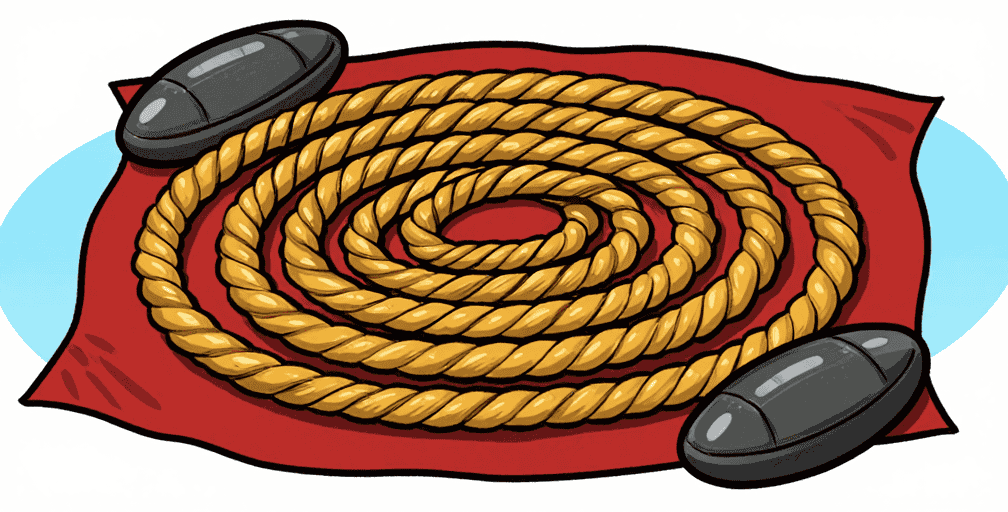
The surujin (スルジン, also written 石投 or 鎖) is a flexible weapon consisting of a rope, cord or chain with weighted ends. It is the only weapon in the Taira curriculum that extends the practitioner's effective range beyond arm's reach through projectile-like throwing and entangling techniques.
Physical Characteristics
| Property | Detail |
|---|---|
| Length | 2–3 m (200–300 cm) total |
| Weights | Stones, metal weights, or shaped metal ends |
| Material | Rope (traditional) or chain (modern) |
| Variants | Tan surujin (short) and naga surujin (long) |
Technique
The surujin is used in several ways:
- Swinging and throwing: the weighted end is swung to build momentum and cast at a target's limbs or weapon
- Entangling: wrapping around an opponent's arm, leg, or neck
- Striking: using the swinging weight as a flail-type impact weapon
- Controlling: a caught limb is pulled off-balance while the other end is ready to strike
The weapon demands significant practice to control because the dynamics of a spinning weighted chain on the end of a rope are unpredictable for beginners.
Kata in the Taira Curriculum
- Surujin no Ichi (スルジンの一): The first surujin kata. Introduces the fundamental throwing, entangling and striking patterns.
- Surujin no Ni (スルジンの二): The second kata with more complex application sequences.
Historical Context
The surujin is likely related to the throwing-stone traditions documented in Okinawan and Chinese military records. The Tsuken sand-throwing techniques preserved in Tsuken Sunakake no Kon (usually classified as an eku kata) show the same conceptual logic: range extension and distraction through thrown or swung objects.
Alternative Naming: Suruchin (スルチン / 棕櫚鎮)
According to Ryukyu Kobudo sources, this weapon is also called suruchin (スルチン, 棕櫚鎮). It connects two striking weapons with rope or chain. The original form used fist‑sized stones tied with palm fiber rope (棕櫚縄, shuro‑nawa). The name "suru" comes from the palm (シュロ, shuro/suru) used for the rope. Like nunchaku, it was used as a hidden weapon (暗器) and hunting tool, swung to strike or entangle opponents' limbs or weapons.
揆奮館 mentions suruchin in the context of China‑influenced flexible weapons (together with sansetsukon), stressing how these required high skill and bodily integration, using the whole body to generate force and control the weapon's path.
Sources
- Surujin — Wikipedia: Physical dimensions (2–3 m rope with weighted ends), usage techniques (throwing, entangling with hōjōjutsu-style wrapping, spike for coup de grâce), classified as chain weapon
- Okinawan kobudō — Wikipedia: Confirms two surujin kata in the Taira curriculum
- Matayoshi Kobudo — Wikipedia: Matayoshi suruchin kata listed as Suruchin no Kata
- Ryukyu Kobudo Weapons: Suruchin naming (棕櫚鎮), fist-sized stones with palm fiber rope (棕櫚縄/shuro-nawa), etymology from palm (シュロ), hidden weapon (暗器) classification, hunting tool origin, striking and entangling techniques
- 琉球古武道武器術 — 揆奮館流武術: China-influenced flexible weapons context, sansetsukon comparison, high skill and bodily integration requirements, whole-body force generation