Tonfa (トンファー)
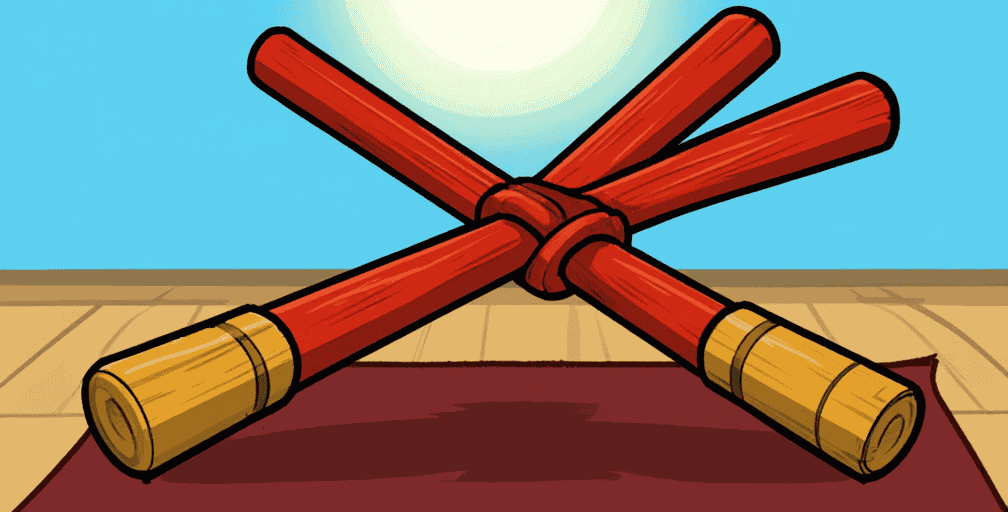
The tonfa (トンファー, also written 答禍 or 当破) is a hardwood weapon with a perpendicular handle set approximately one third of the way along a wooden shaft. Practiced in pairs, it is primarily a close-range striking weapon with a distinctive spinning motion.
Physical Characteristics
| Property | Detail |
|---|---|
| Length | ~45–50 cm (slightly longer than the user's forearm) |
| Handle position | Approximately 15 cm from one end |
| Material | Hardwood (red or white oak) |
| Usage | Held in pairs |
Origin Theory
The most widely cited origin theory is that the tonfa derives from the handle of a traditional millstone (tobira or tofa). This was a heavy wooden peg inserted in the stone; when removed, it could be used as a natural hand weapon. Whether this is historically accurate or a post-war folk etymology is debated.
According to the 揆奮館流武術 article, 柱拐 (tunkuwa / tonfa) is a weapon originating in Fuzhou, China, where the weapon and its techniques were known and the term tonkua is used in the local dialect. The article explains that tonfa developed from the handle of a mortar (臼の柄ヘラ) and was primarily a defensive weapon: held in both hands to receive attacks from swords, spears, or bō, with enough shock power that an opponent's weapon could be knocked from the hand.
Alternative origin theories include the stone mill handle (石臼の挽き棒) and agricultural farming tools (ヘラ). The Ryukyu Kobudo weapons page describes modern tonfa as a "T‑shaped short stick with a side handle", emphasizing its versatility for striking, blocking, and hooking.
Technique
The central technique of tonfa is the spin-and-strike: the weapon pivots forward around the handle grip to deliver a forearm-length strike, then retracts. The back end of the shaft protects the forearm while blocking. At close range the grip can shift to use the handle as a short thrusting club.
The modern police PR-24 baton is directly derived from the tonfa design, which accounts for part of the weapon's wider contemporary familiarity.
Kata in the Taira Curriculum
The Taira line preserves two tonfa kata:
- Yaraguwa no Tonfa (屋良小のトンファー): The first form. Uses all three grips: honte-mochi (natural), gyakute-mochi (reverse) and tokushu-mochi (special). The tokushu-mochi grip, where the shaft is grasped rather than the handle, is particularly characteristic of Yaraguwa.
- Hamahiga no Tonfa (浜比尌のトンファー): The second form, associated with the Hamahiga island lineage also found in the sai kata corpus.
Sources
- Tonfa — Wikipedia: Physical dimensions (~38–51 cm, slightly past the elbow), three grip types (honte-mochi, gyakute-mochi, tokushu-mochi), origin debate (China, Southeast Asia, Okinawa), notes tokushu-mochi used in Yaraguwa kata
- Okinawan kobudō — Wikipedia: Confirms two tonfa kata in the Taira curriculum
- Matayoshi Kobudo — Wikipedia: Matayoshi tonfa kata (Matayoshi no Tunkuwa Dai Ichi/Ni)
- 琉球古武道武器術 — 揆奮館流武術: Fuzhou China origin, mortar handle derivation (臼の柄ヘラ), defensive weapon usage
- Ryukyu Kobudo Weapons: T-shaped short stick description, police adoption worldwide, alternative origin theories (stone mill, farming tools), technique variations
- 琉球古武術 — Japanese Wikipedia: Agricultural tool origins, training requirements